Most tile problems, such as hollow sounds, cracked tiles, uneven edges and stained joints, come from shortcuts during fixing. Follow these steps for a floor or wall that looks good for years.
1. Prepare the surface
The surface must be sound, clean, flat and free of dust, oil and loose material. Fill hollows and correct uneven areas before tiling. In wet areas, waterproof first: Santec 2K Acrylic Waterproof is a brushable membrane for concrete, best used with fibre mesh embedded between coats.
2. Choose the right adhesive
Match the adhesive to the tile, area and surface. Use Santec Bond 304 (C2) for interior floors and walls, Santec Bond Plus 405 (C2TE) for walls and tile-on-tile, Santec Bond Extra 506 or Bond Extra 607 White (C2TES1) for exteriors, pools and stone, and Santec Bond PUA 708 for wood, metal and gypsum. See our guide Which is the best tile adhesive in India?
3. Spread with a notched trowel
Mix the adhesive as directed in the TDS and spread it with a notched trowel to a bed of about 3 mm. Spread only an area you can tile within the open time. For large tiles and stone, also back-butter the tile so it is fully supported with no hollow spots.
4. Keep joints even with spacers
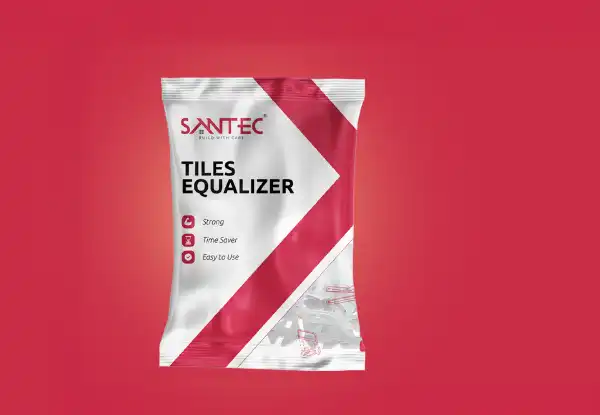
Santec Tile Spacers keep equal joint gaps between wall and floor tiles. Never butt tiles tightly together: joints allow for movement.
5. Level large tiles
Large-format tiles show every step between edges. A clip-and-wedge levelling system keeps them flush: the Santec Levelling Clip sits under the tiles and sets the gap, the Santec Levelling Wedge pushes neighbouring tiles flush, and the Santec Tile Levelling Plier presses the wedges with even force.
6. Grout the joints
Once the adhesive has set, fill the joints. Santec Cementitious Grout suits 1–3 mm joints indoors and outdoors; mix it with Santec Grout Admix instead of water for a more flexible, water-resistant joint with no curing needed. For kitchens, bathrooms and busy floors, use epoxy grout. Read How to apply tile epoxy?
7. Clean up
Remove cement and grout residue from new tiles with Santec Tile Cleaner, a safer substitute for HCl that does not fade tile colour. Do not use Santec Tile Cleaner on marble. For epoxy haze, oil or grease, use Santec HD Cleaner.
Need help choosing a product?
Talk to the Santec team for product advice, pricing and dealer details.